Wednesday, 23 March 2016

#Narrowboat


Living on a narrowboat affords me unlimited opportunity to indulge my other passion- photography. I love social media as a way of expressing myself, Facebook, Pintrest, Tumblr, Flickr, Instagram....I use them all. I also like to use different apps on my smartphone to create photo montages. Using a hashtag # to tag words to the images (such as '#narrowboat' or '#canal'), they can be searched for, viewed and shared by other users. Quite a lot of the photos from this blog have been liked and shared multiple times by people all over the world. I love the connectivity of the internet and a photo encapsulates a feeling, sentiment or a story in any language. As the old adage goes, a picture is worth a thousand words.. So with that mind I will just let the pictures do the talking....


Christmas at Heatons Bridge


Autumn mornings at Ring o Bells


Ring o Bells early spring evening and mornings


Sparks Bridge winter mornings


Crooke winter mornings


Burscough autumn sunsets


Tarleton winter trip


The Kelpies in winter


Autumn leaves


Ruffords late winter and early spring


Working the locks on the Rufford Branch


Tuesday, 15 March 2016

Waste of Time


Of course it's never a waste of time travelling along the cut, especially late afternoon or early evening when there's no one else around on a sunny, still day. The boat glides through the water, cutting through the mirror reflection and everything feels just a little bit better, even if only for a while...


We had previously travelled along the Rufford Branch with the ultimate aim of emptying our waste tank at the Sparks Bridge services. As we still had a week or so left before the job needed to be done, we moored up near the old hall on a particularly pretty part of the canal for a week. 


The following weekend we were ready to move on. The services are only a little further on so Mr F suggested that we extend our cruising by going right to the end of the branch at Tarleton where there is a lock onto the River Douglas. This lock enables boaters to cross onto the isolated Lancaster canal using the 'Ribble Link'. There is a place to 'wind' (turn) the boat there (although we had never been in the current boat so we hoped we could get round or there would be a bit of reversing to do!).


It always feels a privilege to see a beautiful bird of prey hovering in the sky


Snow capped Winter Hill in the distance


Just after this swing bridge we got grounded on a really shallow concrete ledge on the bridge mooring. We should have known better as this has happened to us before but only when it has been really windy , making it hard to keep the front end out whilst trying to reverse or pole the back end out. It wasn't particularly windy but there was enough to cause us a bit of faffing with poles at both end of the boat for fifteen minutes or so. Normally when we go through this bridge it is just to turn round a bit further up, I usually wait at the bridge to save having to stop and Mr F turns the boat and comes back through. We decided that we would avoid getting stuck the way back, I would hop off at a convenient place and walk down to the open the bridge.


Cormorant taking flight 


The canal becomes twisting and turning now as it follows the original line of the River Douglas that was diverted.


The cormorants disappear and pop up huge distances away in such a short time, they are amazing divers. They stand on the banks holding their wings out to dry which make them look like little pterodactyls!


After a mile or so of meandering though the fields with nothing in sight we happen upon a little bridge and old canalside mill


The engine does sound good with our tall exhaust stack reverberating off the stone


There is one final swing bridge and then a long stretch of visitor mooring, presumably for the boats waiting to do the crossing. At this time of year (before the crossings resume with the tides) it was just us and another boat. There is a boatyard just ahead and this was where we took our other boat for epoxy coating the hull. 


The boatyard staff operate the lock and there are moored boats including some more seaworthy looking vessels. It's a bit 'industrial' but all the more interesting for it.


The lock on the right and the River Douglas on the left. The water level was low and the flow quite fast. 


Having successfully turned the boat with an inch or so to spare, I managed to hop off at the point where the bow was in the bank. This meant I could walk up to open the swing bridge saving us stopping twice. It also afforded me this photo opportunity of the River Douglass and the Rufford Branch of the Leeds Liverpool Canal running alongside each other with only a narrow strip of land to separate them


Winding back through the open farmland, taken from the pointy end


The photo above shows where I decided to hop off in preparation for the swing bridge on the return journey. It used to be the river lock onto the Douglas until the new lock was built at Tarleton


The offending swing bridge


It's a bit blurred but the white blob is a barn owl. It is common for them to hunt early evening, especially in winter when food is scarce. It's always a delight to be treated to the sight of these graceful, silent hunters


We arrived back at the services at Sparks Bridge where we planned to stay for the week.  Jack Snipe is a lovely looking boat that has just had a paint freshen up since we were last in these parts


Another boat moored just through the road bridge, framed nicely for the camera


The swans are never far away when there might be a sniff of some food


The following morning greeted by blue skies and perfectly still water...spring is definitely in the air


The next morning, true to form, the British weather gave us some frost!


And with the spring and the frost comes ...Lambs!


Tuesday, 23 February 2016

Highland Fling


This year our canal related wedding anniversary trip took us to the lovely city of Edinburgh and included a visit to both the Kelpies and the Falkirk Wheel. The weather was a bit dull, cold and very windy but it didn't spoil our visit and even made the impressive sculptures look quite dramatic set against the steel sky.


The Kelpies are the work of sculptor Andy Scott who's vision was to create " a contemporary sculptural monument. Water-borne, towering gateways into The Helix, the Forth & Clyde canal and Scotland, translating the legacy of the area into proud equine guardians."


Inspired by the history of local heavy horse use, particularly the Clydesdale, pulling barges on the Forth & Clyde Canal, wagons, ploughs and coalships combined with the mythological 'kelpie', a transforming beast possessing the strength of a hundred horses. 


Fabricated from steel and built on site in just 90 days they are both cutting edge technology and hand crafted artisanship, a tribute to the lost industries of Scotland and a celebration of the bright future the country. The sculptor's father was a Falkirk man, giving the project special significance.


Each Kelpie weighs in at 300 tonnes, is 30 metres high and contains 928 steel plates


The site development included an extension of the Forth & Clyde canal to include an attractive turning pool for boaters and visitor centre. It was really enjoyable and well worth it if you're in the area.


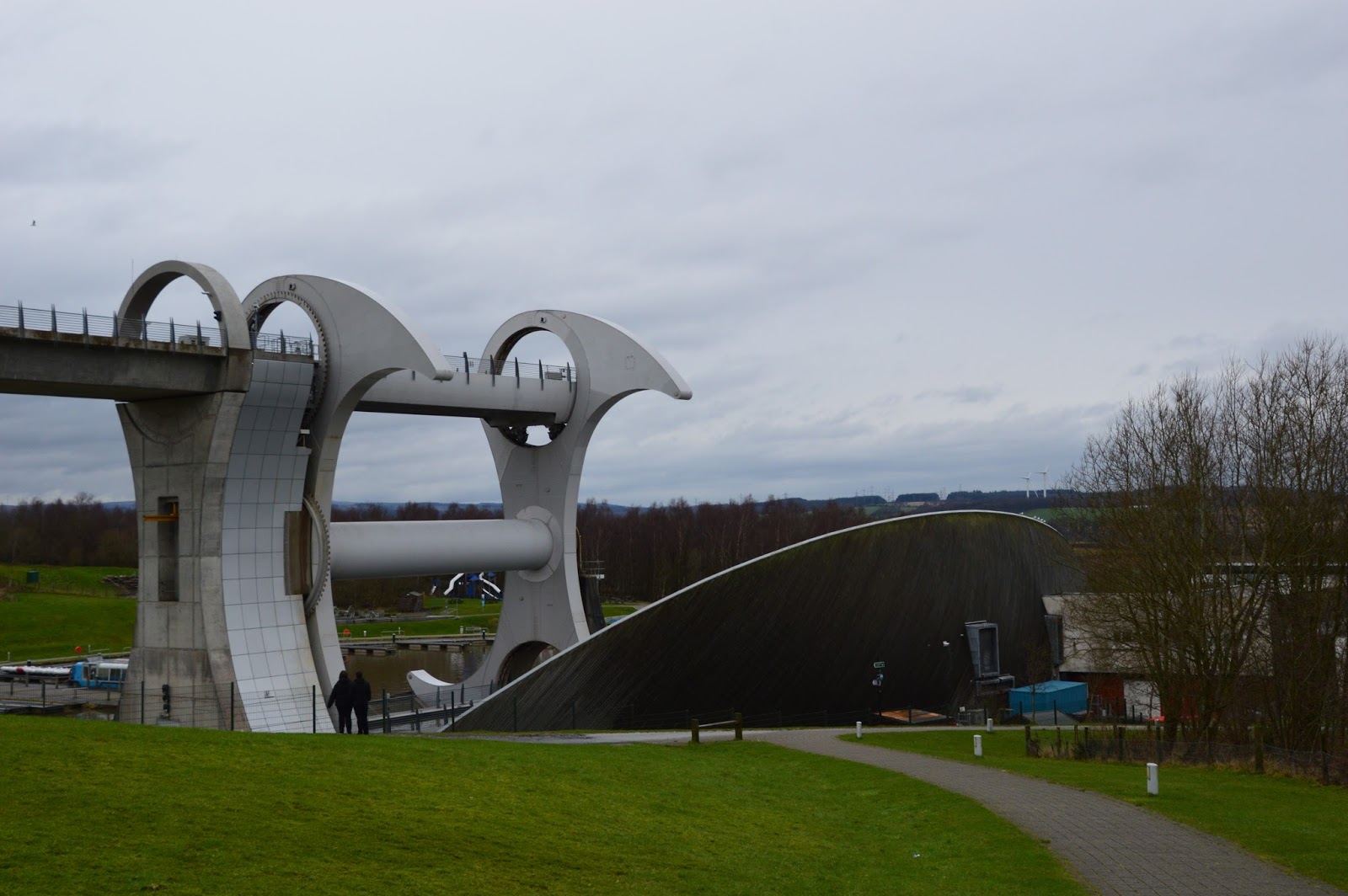
Our next stop was the Falkirk Wheel where we had a boat trip booked to experience the unique rotating boat lift ourselves. Originally the Forth and Clyde and the Union Canals were joined by a staircase flight of eleven locks climbing 35 metres which were dismantled in the 1930's, severing the connection.


During the 1990's several ideas were considered including tilting tanks. The final design is said to have been inspired in part by the Celtic double headed spear. Work started in 1998, being constructed in Derbyshire in parts that were transported by lorry and reassembled on site. Using 1200 tonnes of steel and over 1000 construction staff. The 15,000 bolts used were all tightened by hand! It was officially opened in 2002.


We arrived early enough to see the trip boat ascending before our own trip, enabling us to see the wheel in action from the ground. The wheel works by rotating cog wheels on rails in the larger holes. Powered by hydraulic motors assisted by the weight of the 'caissons' it uses surprising little energy to move. Each water filled caisson works using Archimedes' principle, that floating objects displace their own weight in water, meaning that even when there is only a boat in one, they both weigh the same. 


Once the boat is lifted from the Union Canal that reaches from Falkirk to Edinburgh, there are two locks to raise the link by another 11 metres to join the Forth & Clyde Canal that runs from Grangemouth to Glasgow linking the two cities.


The wheel is not built on the exact site of the original locks as this area has since been developed but instead a short distance away. This led to other obstructions to be overcome including building a length of tunnel 'Roughcastle' in a new culvert to link the canals.


The 1:10 scale Kelpies Maquettes are scale models commissioned to raise awareness of both the sculptures and the wheel and have been displayed in various locations from Sheffield to Chicago and even made an appearance in New York during Scotland Week 2014.


The boat trip was really interesting and the view from the top of the wheel on the return journey was good despite the weather. 


As with the Kelpies we had a thoroughly enjoyable visit which I would recommend to any canal enthusiast. We returned to the city to enjoy a nice meal out and had a walk up the Royal Mile to the castle which was all lit up. There is a great view from the castle to the lower levels of Edinburgh.

Edinburgh Castle


Looking back down the Royal Mile


Useful information can be found at the sites below:

www.thehelix.co.uk

www.scottishcanals.co.uk/falkirk-wheel